
How AI Is Changing SEO: From Keywords to Intent

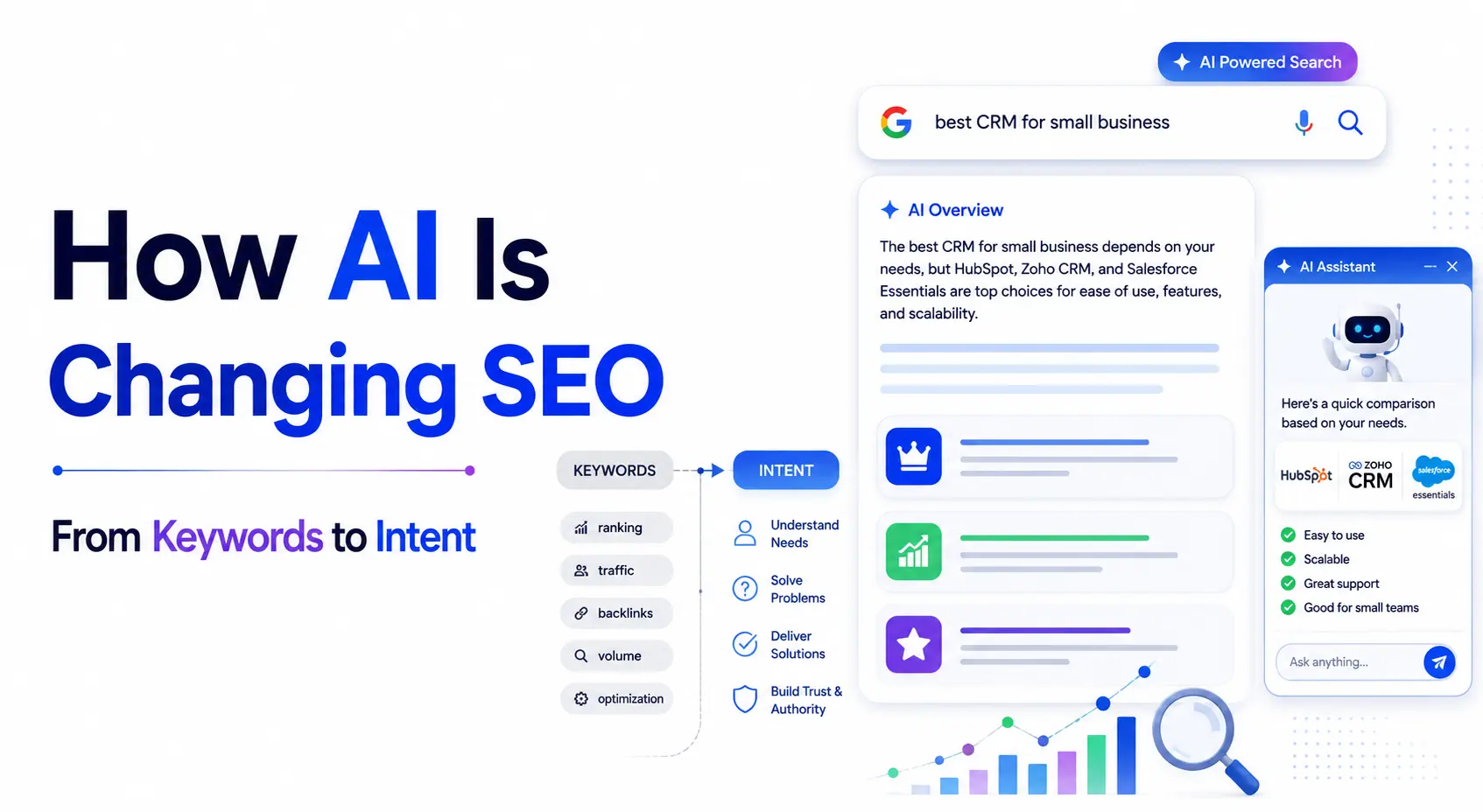
How AI Is Changing SEO: From Keywords to Intent
AI has fundamentally changed how search works. Rankings alone no longer drive traffic. Today's SEO requires understanding user intent, building topical authority, and optimizing for AI-driven search environments — not just matching keywords.
AI has changed how search works — and most businesses are still using strategies built for a version of search that no longer exists.
If your organic traffic is declining despite stable or improving rankings, you're not imagining it. According to Semrush's 2024 State of Search report, average organic click-through rates have dropped significantly as Google's AI Overviews, featured snippets, and direct answer formats now resolve many queries before users ever click a link. SparkToro research suggests that over 58% of Google searches in the US now end without a website visit.
This article explains exactly what has changed, why your SEO results may be suffering, and what you need to do differently in 2026 to maintain and grow your search visibility.
Why Businesses Feel SEO "Isn't Working" Anymore
Many businesses are investing more in content than ever — and getting less in return. The frustration is real, but the diagnosis is usually wrong.
The problem isn't that SEO is dying. The problem is that most businesses are measuring SEO using outdated expectations in a fundamentally new search environment.
The old journey looked like this:
Today, that journey is far more complicated. Search behavior has changed because AI has changed how results are displayed and how users interact with them.
Users now:
- Ask longer, more conversational questions
- Get answers directly inside search results via AI Overviews
- Use AI tools like ChatGPT or Perplexity instead of Google for many queries
- Make decisions without visiting multiple websites
As a result, organic click-through rates are declining, zero-click searches are increasing, and rankings alone no longer guarantee meaningful traffic.
Businesses still following keyword-centric SEO strategies built for 2018 are competing in a 2026 search environment — and losing.
What Traditional SEO Was Built On
To understand where SEO is going, it helps to understand what it was.
For years, SEO was primarily a keyword optimization game. The strategy was simple:
- Find high-volume keywords
- Optimize pages around those exact phrases
- Build backlinks using matching anchor text
- Watch rankings improve
A business targeting "best software development company in Kerala" would repeat that phrase in headings, meta tags, and body copy as many times as possible. And it worked — because older search engines relied heavily on keyword matching to determine relevance.
AI changed that completely. Modern search systems don't just match words. They analyze meaning, intent, context, and content quality. That shift changed everything about how SEO works.
How Search Engines Became Answer Engines
Search engines are no longer just search engines. They are becoming answer engines.
Previously, search results were a list of links. Users opened several pages, compared information manually, and found their own answers. Today, AI helps search systems:
- Understand the meaning and context behind a query
- Interpret what the user actually wants
- Combine information from multiple sources
- Generate a direct, summarized response instantly
When someone searches "what's the best remedy for acne-prone skin?", Google may now generate a comprehensive answer directly on the results page — before showing a single website link.
This shift accelerated with:
- Google AI Overviews — AI-generated summaries at the top of search results
- Conversational AI tools — ChatGPT, Google Gemini, Perplexity AI
- Answer-based search experiences — direct responses replacing traditional link lists
Search systems are no longer asking "which page contains this keyword?" They are asking: "Which source provides the best answer to the user's actual problem?" That is the foundation of AI-driven SEO.
Search Is No Longer Just About Google
One of the most significant — and underappreciated — shifts in search is this: users have more options than ever for finding information.
Earlier, most online discoveries started on Google. Today, users increasingly go directly to AI systems:
- ChatGPT for research, recommendations, and explanations
- Google Gemini for integrated search + AI responses
- Perplexity AI for cited, conversational answers
- Microsoft Copilot for productivity-integrated search
- AI-powered social search on platforms like Reddit, TikTok, and YouTube
Instead of typing "best CRM software," users now ask: "What's the best CRM for a small business with a remote sales team that needs pipeline tracking and Slack integration?"
AI systems respond with comparisons, recommendations, and personalized suggestions — often without the user visiting a single website.
Businesses are no longer just competing for rankings. They are competing for mentions, citations, recommendations, and AI visibility. This is where newer optimization disciplines — AEO (Answer Engine Optimization) and GEO (Generative Engine Optimization) — become critical.
AEO vs GEO — What's the Difference?
All three optimization disciplines matter now. Businesses that only optimize for traditional rankings are missing two growing discovery channels.
| Term | What It Means |
|---|---|
| AEO (Answer Engine Optimization) | Optimizing content to be selected as the direct answer in AI-generated responses and featured snippets |
| GEO (Generative Engine Optimization) | Optimizing for visibility and citation inside generative AI tools like ChatGPT, Gemini, and Perplexity |
| Traditional SEO | Optimizing for ranking positions in Google's organic results |
The Shift From Keywords to Intent
Keywords still matter. But intent matters far more. This is one of the most important changes AI brought to SEO. Search systems no longer just match words — they try to understand:
- Why the user is searching
- What problem they want to solve
- What type of answer they expect
- Where they are in the decision-making process
Consider the keyword "best software development company." Different users searching the same phrase could have completely different needs:
- One wants pricing information
- Another is comparing agencies on quality
- A third wants to read client reviews
- A fourth is ready to hire immediately
Same keyword. Completely different intent. Content that satisfies one may frustrate the others. That's why AI-driven search systems reward content that best satisfies the underlying need behind the search — not just content that contains the right keywords.
The 4 Types of Search Intent
Understanding intent is foundational to creating content that actually performs.
1. Informational Intent
The user wants to learn something.
2. Navigational Intent
The user is trying to find a specific brand or page.
3. Commercial Intent
The user is researching before making a decision.
4. Transactional Intent
The user is ready to act.
How AI Actually Understands Your Content
AI does not read content the way humans do. It analyzes meaning, relationships, context, and semantic relevance. This is why modern SEO has shifted away from keyword repetition toward semantic SEO.
Earlier, repeating a keyword multiple times signaled relevance to search engines. Today, AI systems understand relationships between concepts.
A page about SEO strategy that naturally discusses search intent, user experience, topical authority, content optimization, and E-E-A-T signals deep expertise because these concepts are semantically related. The AI connects them together to assess the overall quality and authority of the content.
Old SEO vs New SEO: What's Changed
| Traditional SEO | AI-Era SEO |
|---|---|
| Keyword density | Semantic relevance and topic depth |
| Exact-match keywords | Natural language and user intent |
| Backlink volume | Topical authority and content trust |
| Meta tag optimization | Structured content and E-E-A-T |
| Ranking position | AI visibility, citations, and featured snippets |
| Blog quantity | Content ecosystem and interconnected coverage |
| Any traffic | Qualified traffic + user satisfaction signals |
Why Traditional SEO Tactics Are Losing Effectiveness
Several SEO practices that worked reliably for years are now actively counterproductive.
Keyword Stuffing
Repeating keywords unnaturally reduces content quality and harms readability. AI systems penalize this because it signals that content is optimized for algorithms, not for users.
Thin Content
Short, surface-level posts that skim a topic without depth struggle to rank. AI systems prefer complete, well-structured answers that genuinely help users.
Ignoring User Experience
Even strong content underperforms if the page is slow, hard to navigate, or poor on mobile. User experience signals — dwell time, bounce rate, engagement — are increasingly used as quality indicators.
Ignoring Semantic Coverage
Publishing content about a topic without covering related subtopics sends weak authority signals. Depth beats breadth in AI-era SEO.
What Modern SEO Actually Requires in 2026
SEO today is not just about rankings. It is about being the most useful, trustworthy, and relevant answer — wherever users search.
The Modern SEO Framework
Here's how the new SEO process should work:
| Stage | What It Means | What to Do |
|---|---|---|
| Search Intent | Why is the user searching? | Map content to informational, commercial, or transactional intent |
| Content Experience | Is the content clear, structured, and useful? | Use H2/H3 hierarchy, short paragraphs, direct answers |
| Trust & E-E-A-T | Does the site demonstrate real expertise? | Add author credentials, cite sources, include original examples |
| AI Visibility | Can AI systems extract and cite your content? | Use FAQ sections, schema markup, and concise summaries |
| Conversion | Does the content guide users toward action? | Add relevant CTAs and logical next steps |
Businesses that align all five stages build compounding search visibility over time.
Recommended Tools for AI-Era SEO
| Tool | Use Case |
|---|---|
| Semrush / Ahrefs | Keyword research, topical gap analysis, backlink tracking |
| Surfer SEO / Clearscope | Semantic keyword coverage and content optimization |
| Google Search Console | Impressions, CTR, ranking position, and indexing data |
| Screaming Frog | Technical SEO audit and schema validation |
| Schema.org + Google Rich Results Test | Structured data implementation and testing |
| Perplexity AI / ChatGPT | Competitive research and AI visibility testing |
| Google Trends | Emerging topic discovery and seasonal content planning |
How Businesses Should Adapt in 2026
The search landscape will continue evolving rapidly. Here's what to prioritize:
- Stop Measuring Rankings Alone — Focus on conversions, qualified traffic, and business outcomes. A page ranking #1 for a zero-click query has limited business value.
- Build Topical Authority Intentionally — Create deep, interconnected content around your core expertise. Map out the full topic universe, then build content that covers it systematically.
- Optimize for Multiple Search Channels — Discovery now happens on Google, AI assistants, YouTube, Reddit, LinkedIn, and more. Strong SEO includes multi-platform visibility.
- Prioritize Original, Experience-Based Content — Generic information is everywhere. Content that demonstrates real expertise, shares original insights, and reflects genuine experience stands out both to readers and AI systems.
- Implement Structured Data — Schema markup is one of the highest-leverage, lowest-adoption tactics for improving AI visibility. Most businesses still aren't using it.
FAQ: AI and SEO in 2026
The Future Belongs to Businesses That Provide Genuine Value
SEO is not disappearing. It is transforming.
The businesses that will win in AI-driven search are the ones that combine human expertise with smart optimization — creating content that is genuinely useful, demonstrably trustworthy, and technically structured for the way modern search works.
Keywords still matter. But they are now just the starting point, not the strategy.
In 2026 and beyond, the goal of SEO is no longer to rank a page. It's to become the most useful, credible, and relevant answer — wherever users search, on whatever platform they use, in whatever format they prefer.
That shift is both a challenge and an opportunity. Businesses that adapt early will gain a compounding competitive advantage. Those that don't will find their visibility gradually eroding, regardless of how much they invest in outdated tactics.